
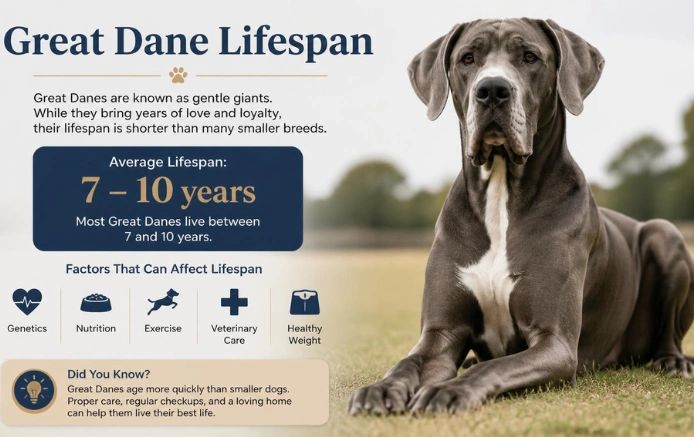
Owning a giant dog means planning for a shorter life than many smaller breeds. The Great Dane lifespan is usually 7 to 10 years, though individual lifespans vary. Understanding major health risks can help you plan preventive care and recognize emergencies earlier.
| Key fact | What U.S. owners should know |
| Typical lifespan | About 7–10 years |
| AKC estimate | Usually 8–10 years |
| Exceptional longevity | Some dogs reach 12 years |
| Senior stage | The final 25% of estimated life, according to AAHA |
| Major health concerns | GDV/bloat, heart disease, cancer, thyroid disease, and orthopedic problems |
| Most useful owner actions | Healthy weight, veterinary care, emergency awareness, and responsible breeding |
Most Danes live about seven to ten years, while the AKC commonly gives an eight-to-ten-year range. Some dogs die younger, while a smaller number reach 12 years. Genetics, giant body size, serious disease, body condition, and preventive veterinary care all affect an individual dog’s outcome.
Key takeaway: A lifespan estimate is a planning range, not an expiration date. Owners cannot control genetics or every illness, but they can manage weight and routine care. Knowing the signs of bloat and discussing breed-specific screening with a veterinarian can also improve health planning.
For more canine guides on Magclone, readers can browse the Pets section. The site also covers different dog breeds and sizes for owners comparing breeds.
How Long Is the Great Dane Lifespan?
Most veterinary and breed references place these dogs near the shortest end of canine longevity. PetMD gives an expected range of seven to ten years. The AKC commonly lists eight to ten years, while acknowledging some dogs reach 12. Great Dane Lifespan estimates can therefore vary depending on the source and population studied.
Those figures are population estimates, not promises for an individual pet. A healthy dog may live beyond the common range. Another may develop serious disease much earlier despite attentive care.
Recent research also shows why you shouldn’t treat one number as universal. Large datasets produce different lifespan estimates because populations and methods vary. Breed-club guidance remains useful for practical planning in the United States.
Why Do These Giant Dogs Have Shorter Lives?
Body size strongly relates to canine longevity. Giant breeds generally have shorter lives than smaller dogs. AKC guidance puts giant breeds at about eight to ten years on average.
Researchers still study the biological reasons behind that pattern. Rapid growth, cellular aging, cancer risk, and other size-related factors may contribute. No single mechanism explains every dog’s lifespan.
A Dane also reaches an enormous adult size quickly. That growth places unusual demands on bones, joints, and other body systems. Genetics and breed-specific diseases add another layer of risk.
Health Problems That Can Affect Longevity
Several conditions deserve extra attention because they occur more often in this breed. The parent club highlights bloat, heart disease, cancer, and autoimmune conditions among significant concerns. These risks do not mean every dog will develop them.
| Health concern | Why it matters | What owners can discuss with a veterinarian |
| Gastric dilatation-volvulus | A rapidly progressing, life-threatening emergency | Warning signs and preventive gastropexy |
| Dilated cardiomyopathy | Weakens the heart’s pumping ability | Cardiac examinations and breed-specific screening |
| Cancer | Giant breeds face meaningful cancer risk | New lumps, pain, appetite changes, or unexplained weight loss |
| Thyroid disease | Can affect metabolism and general health | Appropriate blood testing when indicated |
| Orthopedic disease | Large body size places heavy loads on joints | Weight control, exercise, pain, and mobility |
Gastric dilatation-volvulus, commonly called GDV or bloat, deserves special attention. ACVS describes it as a rapidly progressing emergency requiring immediate medical care. The breed is among those commonly affected.
Warning signs can include repeated unproductive retching, drooling, abdominal swelling, restlessness, weakness, or collapse. Do not watch a suspected episode at home for improvement. Emergency veterinary evaluation is the appropriate response.
Heart health also deserves discussion during routine visits. Dilated cardiomyopathy occurs particularly often in several large breeds, including Danes. It may progress before obvious symptoms become visible.
When Is a Dane Considered a Senior?
There is no universal birthday when every dog becomes senior. AAHA defines the senior stage as the final 25% of a dog’s estimated lifespan. Breed, size, health, and individual condition therefore matter.
For a giant breed with a relatively short expected life, aging discussions may begin earlier than owners expect. AKC material notes that larger dogs may be considered senior around five or six. Your veterinarian can interpret that framework for your individual pet.
Senior status does not mean a dog is automatically unhealthy. It means preventive care may need to change as risks increase. Mobility, body condition, dental health, heart health, and laboratory screening may receive closer attention.
How to Support More Healthy Years
No feeding plan, supplement, surgery, or routine can guarantee a longer life. Owners can still reduce avoidable risks and support quality of life. The most useful approach combines daily care with individualized veterinary guidance.
- Keep body condition lean and healthy. WSAVA uses body-condition scoring to assess fat stores, with 4–5 out of 9 as a common goal.
- Use appropriate nutrition throughout life. Ask your veterinarian about food suited to age, growth, weight, activity, and medical history.
- Schedule regular veterinary examinations. AAHA recommends veterinary visits every 6–12 months, with frequency adjusted to individual needs.
- Ask about GDV prevention. ACVS says prophylactic gastropexy may be recommended for large or giant dogs at increased risk.
- Know your breeder’s health-testing history. The breed club recommends hip, cardiac, thyroid, and eye testing for breeding dogs.
- Respond early to physical changes. New breathing problems, collapse, pain, swelling, reduced appetite, or mobility changes deserve veterinary attention.
Dietary extras also matter because extra calories can accumulate over time. Magclone’s guide to feeding bread to dogs safely explains why human foods should remain limited. Your veterinarian can set a calorie target based on body condition and activity.
Regular movement helps maintain muscle and mobility, but exercise should suit the dog’s health. Pain or exercise intolerance should trigger a veterinary discussion. Growing puppies also need activity choices appropriate for developing bodies.
Does Sex, Color, or Size Predict an Individual Dog’s Lifespan?
Owners often ask whether males or females consistently live longer. Available breed information does not provide a reliable rule for predicting one pet’s lifespan from sex alone. Health history, genetics, disease, and body condition offer more useful context.
Coat color should not be used as a simple longevity calculator either. Specific genetics can affect health, but appearance alone offers little certainty. Responsible breeding decisions depend on documented health information, not color assumptions.
Size matters more clearly at the population level. Giant dogs generally live fewer years than smaller breeds. Even so, an individual dog can fall above or below any published average.
Can Great Danes Reach 12 Years?
Yes, reaching 12 is possible, but it is outside the typical range. AKC notes that a fortunate minority reach about 12 years. Owners should treat that age as an exceptional outcome rather than the expected target.
Record-setting age claims can be difficult to verify. Different websites sometimes repeat extraordinary ages without reliable documentation. A practical care plan should use established breed ranges rather than anecdotal records.
Longevity is also only one part of the picture: comfort, mobility, appetite, social engagement, and freedom from uncontrolled pain matter throughout senior life. Veterinary care should focus on both length and quality of life.
Choosing a Puppy With Health in Mind
Responsible breeding cannot eliminate every future illness. It can provide useful information about known inherited and breed-associated risks. The Great Dane Club of America emphasizes health testing when breeding these dogs.
The OFA CHIC program records breed-specific screening information in a public database. A CHIC number means required tests were completed and made public. It does not mean every test result was normal.
Prospective owners can ask for actual health-test results before choosing a breeder. They can also ask about longevity among parents and close relatives. Magclone’s guide to different types of pet dogs provides added context for breed selection.
The Bottom Line for Owners
The shorter expected life is one of the realities of sharing your home with this giant breed. Good care cannot control every risk, but it can protect comfort and catch problems sooner. Build a preventive plan with a veterinarian who knows your dog’s history.
Learn the emergency signs of GDV before you ever need that information. Keep weight and body condition under regular review throughout adulthood. Owners can find more everyday canine resources in Magclone’s Pets hub.
For routine coat-care reading, Magclone also explains common dog grooming tools and how they differ. Nutrition, grooming, exercise, and medical care all form part of responsible ownership. Your veterinarian remains the best source for recommendations tailored to an individual animal.
Frequently Asked Questions
Can a Great Dane live 12 years?
Yes, some individuals reach 12 years. That age sits beyond the common seven-to-ten-year range. Genetics, health history, disease, and care all contribute to individual variation.
Is seven years old for a Dane?
Seven can represent a later life stage for this giant breed. AAHA bases senior status on the final quarter of the expected lifespan rather than a single universal age. A veterinarian can assess senior needs more accurately than a birthday alone.
How can I improve the Great Dane lifespan?
Focus on healthy body condition, preventive veterinary care, safe nutrition, and early attention to concerning symptoms. Discuss GDV prevention and breed-specific health risks with your veterinarian. These actions support health, but none can guarantee a particular lifespan.
Why do giant breeds usually live fewer years?
Large body size is strongly associated with shorter canine lifespan. Researchers continue examining the biological reasons behind this relationship. Faster growth and differences in age-related disease appear to contribute.
How often should an older Dane see a veterinarian?
Visit frequency should match your dog’s health and veterinary recommendations. AAHA describes six-to-twelve-month veterinary visits as important across canine life stages. Senior animals or dogs with chronic disease may need more frequent monitoring.