
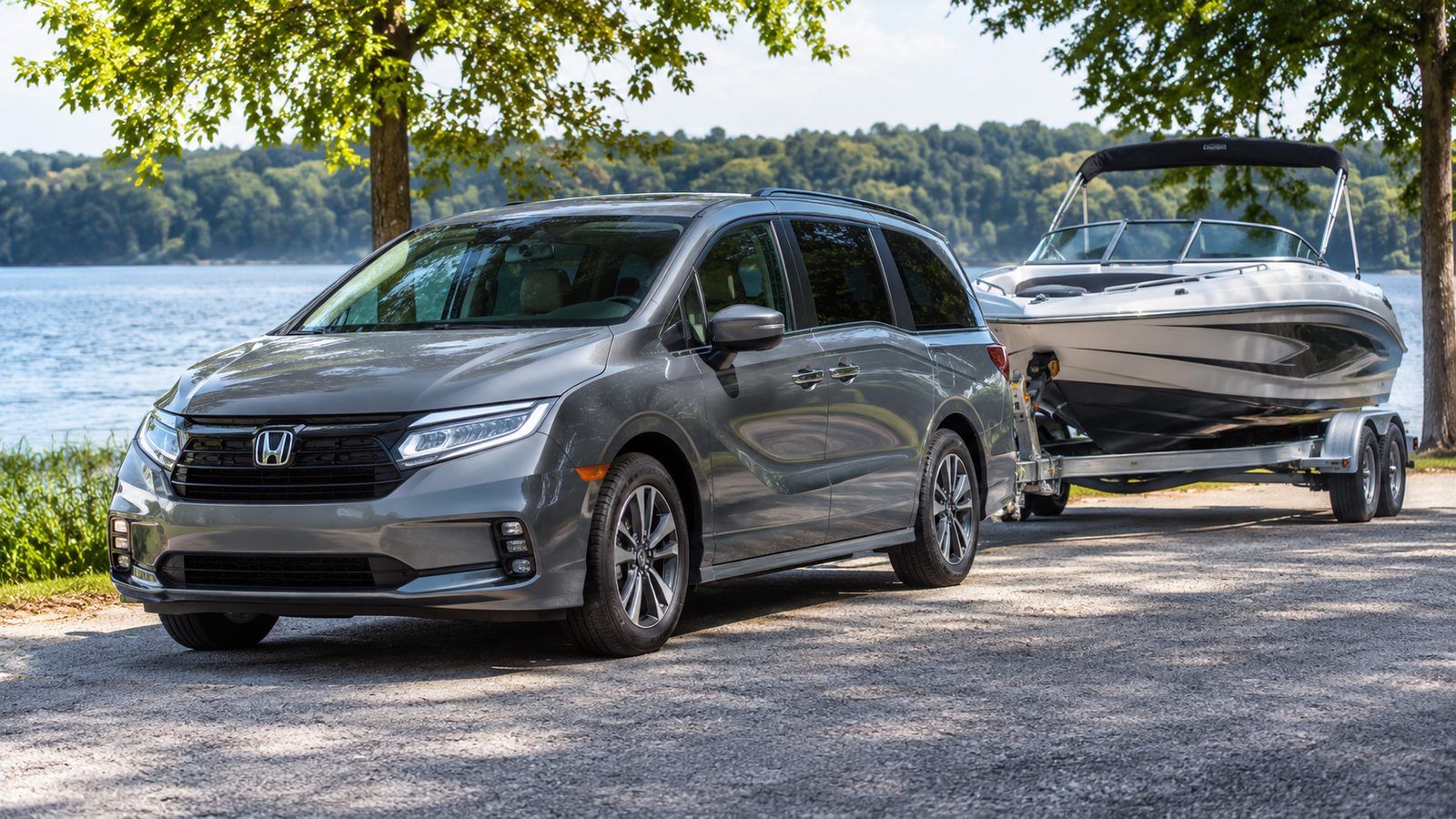
The Honda Odyssey towing capacity reaches 3,500 pounds for the 2025 model year when properly equipped. That figure applies to every 2025 trim, but several conditions come with it. Your passengers, cargo, trailer setup, and tongue weight still affect safe towing. Honda also published different ratings for some earlier models. The 2018 LX, EX, and EX-L were rated up to 3,000 pounds. The 2018 Touring and Elite were rated up to 3,500 pounds when properly equipped. Quick answer: A properly equipped 2025 Odyssey can tow up to 3,500 pounds across all trims. For 2018, LX, EX, and EX-L models were rated to 3,000 pounds. Touring and Elite models reached 3,500 pounds. Actual usable capacity can decrease once passengers, cargo, and tongue weight enter the calculation.
| Model year and trim | Maximum published trailer rating | Important conditions |
|---|---|---|
| 2025 EX-L | 3,500 lb | Honda towing package, hitch ball, trailer brakes |
| 2025 Sport-L | 3,500 lb | Honda towing package, hitch ball, trailer brakes |
| 2025 Touring | 3,500 lb | Honda towing package, hitch ball, trailer brakes |
| 2025 Elite | 3,500 lb | Honda towing package, hitch ball, trailer brakes |
| 2018 LX | 3,000 lb | Proper Honda towing equipment required |
| 2018 EX | 3,000 lb | Proper Honda towing equipment required |
| 2018 EX-L | 3,000 lb | Proper Honda towing equipment required |
| 2018 Touring | 3,500 lb | Proper Honda towing equipment required |
| 2018 Elite | 3,500 lb | Proper Honda towing equipment required |
2025 Honda Odyssey towing capacity
For the 2025 model year, Honda lists a maximum towing capacity of 3,500 pounds on every trim. Those trims are EX-L, Sport-L, Touring, and Elite. The rating is not a promise that every 3,500-pound trailer combination is suitable. Honda places specific requirements on that maximum rating. The vehicle needs the available Honda accessory towing package and hitch ball. Honda also requires surge-type or electric trailer brakes for the published rating. Honda recommends premium unleaded fuel while towing the 2025 model. That advice differs from normal operation, where regular unleaded is listed as the recommended fuel. Owners planning frequent towing should follow the towing guidance in their manual.
2018 towing limits depended on the trim
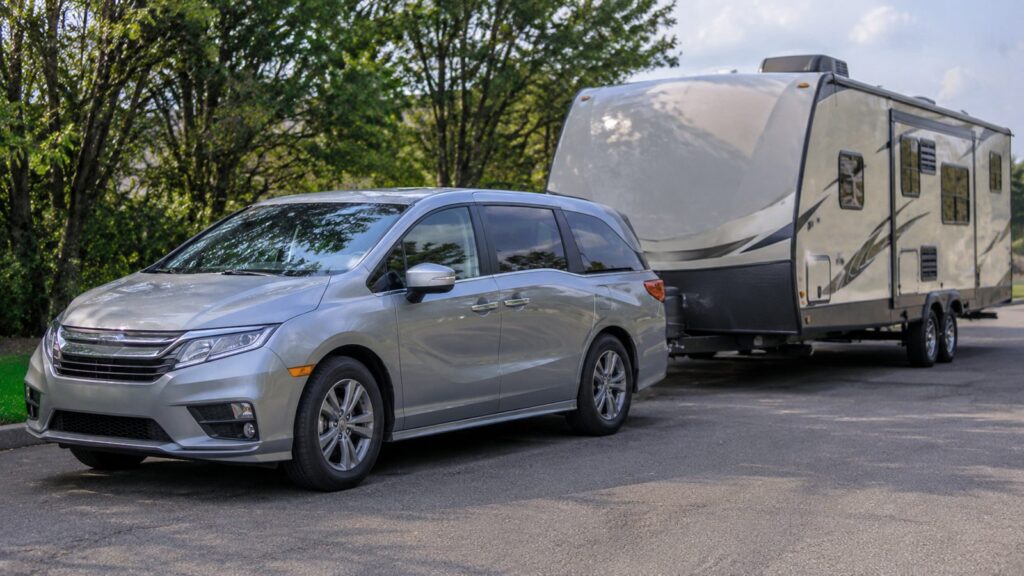
The 2018 model year requires more attention because the maximum varied by trim. Honda rated LX, EX, and EX-L models at up to 3,000 pounds. Touring and Elite models received a higher 3,500-pound maximum rating. Honda tied these ratings to its accessory towing package. The company described that package as including a Class II hitch and wiring connector. Proper equipment matters because a hitch rating alone cannot increase the vehicle’s approved towing limit. Passenger count can also change how much weight is available for a trailer. Honda’s towing guidance accounts for people and cargo inside the van. Treat the advertised maximum as an upper boundary, not an automatic working limit.
Why passengers and cargo reduce your usable towing capacity
A minivan can reach several different weight limits before its advertised tow rating becomes the problem. People, luggage, accessories, and trailer tongue weight all load the vehicle. More weight inside therefore leaves less room within the vehicle’s total weight limits. Honda’s towing guidance specifically warns owners to stay within all applicable load limits. It also notes that added cargo and accessories can reduce trailer and tongue-load capacity. Checking only the trailer’s advertised empty weight can give you an incomplete picture. Use the trailer’s loaded weight when planning a trip. Include water, batteries, coolers, camping gear, fuel, and equipment carried on the trailer. Then account for everything carried inside the van before deciding whether your combination works.
How much tongue weight should an Odyssey have?
Honda says trailer tongue weight should be approximately 10% of the total loaded trailer weight. A 3,000-pound loaded trailer would therefore have roughly 300 pounds on the hitch. A 3,500-pound loaded trailer would place about 350 pounds there at the same ratio. Too much tongue weight can reduce front-tire traction and steering control. Too little can allow the trailer to become unstable or sway. Correct loading therefore matters as much as staying below the headline trailer rating. Tongue weight also counts as load carried by the tow vehicle. That means it competes with passengers, luggage, and accessories for available vehicle capacity. Check the owner’s manual and door-jamb loading information before setting your final trailer weight.
What can a 3,000- to 3,500-pound rating realistically tow?
A 3,000- to 3,500-pound limit works best for relatively light recreational and utility trailers. Many small pop-up campers can fall within this range when loaded carefully. A lightweight utility trailer carrying modest household or recreational cargo may also fit. Personal watercraft are another realistic use. One or two jet skis with a suitable trailer can sometimes remain comfortably below the limit. You still need the actual loaded trailer weight rather than an estimate based on the watercraft alone. Small boats may also qualify when the complete package stays within every vehicle limit. Include the boat, motor, fuel, batteries, equipment, and trailer. Weighing the finished combination gives you a better answer than relying on brochure dry weights.
What should you avoid towing?
The Odyssey is not intended to replace a pickup or large SUV for heavy trailer work. Many conventional travel trailers exceed 3,500 pounds once camping equipment, water, propane, and batteries are added. Larger boats can cross the limit for the same reason. A vehicle trailer carrying another car will usually be too heavy. Large enclosed cargo trailers can also exceed the rating quickly after loading. Fifth-wheel and large travel trailers are outside the practical scope of this minivan. Shoppers comparing other family vehicles can also read our 2020 Lexus NX specs and safety guide. Avoid choosing a trailer because its empty weight sits barely below 3,500 pounds. That leaves little room for equipment and supplies. A reasonable safety margin makes trip planning easier and reduces the chance of exceeding another vehicle limit.
The towing package matters
The published 2025 maximum assumes the specified Honda accessory towing equipment. Installing an aftermarket receiver with a larger number stamped on it does not raise the vehicle’s rating. The lowest applicable vehicle or equipment limit always controls the setup. For 2025, Honda specifically calls for the accessory towing package and hitch ball. It also requires surge-type or electric trailer brakes for the maximum rating. Those conditions should be checked before comparing your trailer against the 3,500-pound figure. The 2018 ratings also assumed proper Honda towing equipment. Honda’s press information describes a dealer-installed package for those models. Owners of used vans should confirm what equipment is already installed before towing.
Trailer brake rules vary across the United States
Trailer-brake laws are not identical in every state. Requirements can depend on trailer weight, trailer type, or other conditions. A trailer legal without brakes in one situation may face different requirements elsewhere. Honda’s own 2025 maximum rating still requires surge-type or electric trailer brakes. That manufacturer requirement matters even if local law might allow something different. Following the stricter applicable requirement is the safer approach. Check the laws for every state on your route before a long trip. Pay attention to brake, lighting, safety-chain, and breakaway requirements. Rules can change, so verify them with the relevant state authority before departure.
Safe towing tips for Odyssey owners
Start with verified weights instead of relying on guesses. A public scale can help confirm the loaded trailer and combined vehicle setup. Recheck the load after adding camping supplies, water, or other heavy equipment.
- Check your exact model year’s owner’s manual before towing.
- Confirm the installed hitch and towing package match Honda’s requirements.
- Keep trailer weight below the applicable maximum after loading.
- Aim for tongue weight near 10% of loaded trailer weight.
- Include passengers, luggage, accessories, and tongue weight in your calculations.
- Use the required trailer brakes and test them before leaving.
- Check tire pressures on the van and trailer.
- Secure cargo so weight cannot shift during travel.
- Leave greater braking distance than you use without a trailer.
- Reduce speed if the trailer begins to sway or conditions deteriorate.
Take hills, crosswinds, rain, and high temperatures seriously. A combination near its maximum rating has less reserve for difficult conditions. Slower speeds and conservative loading usually make towing more predictable. If you also drive in winter weather, our guide to a good SUV in snow covers more on staying confident on snow-covered roads.
What about older Honda Odyssey model years?
Older generations should be checked individually rather than grouped under one towing number. Equipment requirements and allowable weights changed across generations and configurations. Giving one universal figure for older vans could mislead an owner. Use the owner’s manual for your exact model year and configuration. Check its towing-load tables, required equipment, and passenger-related limitations. Your door-jamb labels also provide important vehicle weight information. If the manual and a hitch label show different numbers, do not use the larger number automatically. A stronger hitch cannot increase the manufacturer’s vehicle rating. Follow the lowest applicable limit for the complete combination.
Frequently asked questions
What is the Honda Odyssey towing capacity for 2025?
The Honda Odyssey towing capacity is up to 3,500 pounds for every 2025 trim. Honda requires its accessory towing package, hitch ball, and appropriate trailer brakes for that rating. Honda also recommends premium unleaded fuel when towing.
Can a Honda Odyssey tow a camper?
Yes, some lightweight campers can fit within the van’s towing limits. Small pop-up campers are usually more realistic than larger conventional travel trailers. Always compare the camper’s loaded weight against your exact owner’s manual limits.
Can an Odyssey tow 3,500 pounds with passengers inside?
Do not assume the full rating remains available in every loading situation. Passengers, cargo, accessories, and tongue weight contribute to vehicle loading. Check Honda’s load limits for your exact model before towing near the maximum.
How much tongue weight should I use?
Honda recommends tongue weight of approximately 10% of total loaded trailer weight. That equals about 350 pounds on a 3,500-pound trailer. Correct tongue weight helps maintain steering control and trailer stability.
Does the Odyssey need trailer brakes?
Honda requires surge-type or electric trailer brakes for the published 2025 maximum towing rating. Trailer brake laws also vary between U.S. states. Check both Honda’s requirements and the laws covering your route.
Bottom line
The Odyssey can handle useful light-duty towing when equipped and loaded correctly. The 2025 model is rated up to 3,500 pounds across all trims. The 2018 model ranges from 3,000 to 3,500 pounds depending on trim. Those maximums are only the starting point for safe planning. Passengers, cargo, tongue weight, trailer equipment, and legal requirements still matter. Check your exact owner’s manual before buying a trailer or starting a towing trip. For an older model year, avoid relying on a generic online number. Match the manual to the exact year and configuration you own. That approach gives you the safest answer without assuming ratings Honda did not publish for your vehicle. —