
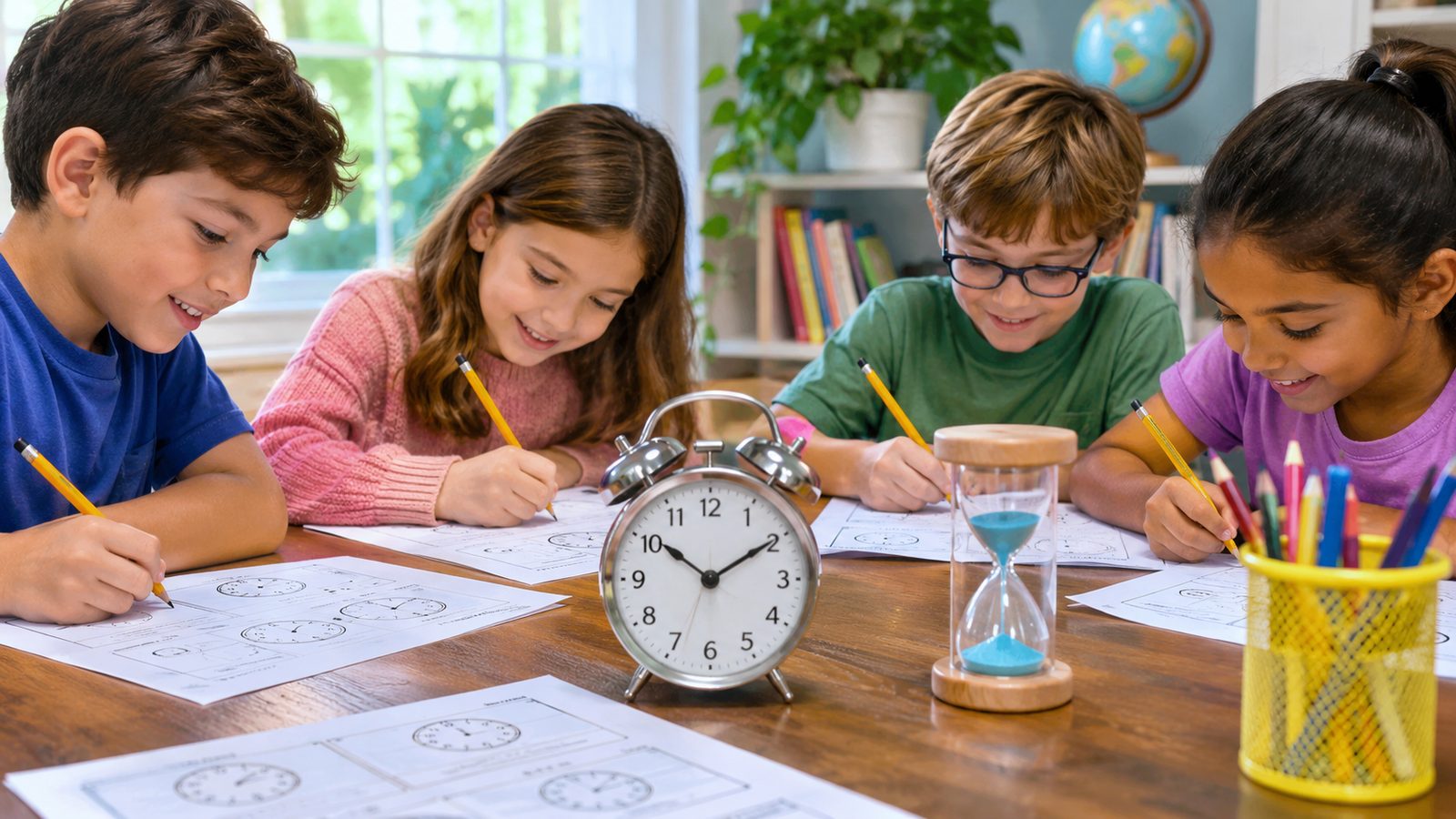
Elapsed time worksheets help children understand how much time passes between two points on a clock. For grades 2 through 5, the skill grows from simple whole-hour questions to multi-step problems. The practice below moves through those levels while showing students several ways to solve each type. Quick answer: Elapsed time means the amount of time between a starting time and an ending time. Students can solve these problems by counting forward on a number line, using a T-chart, moving clock hands, or breaking the interval into friendly jumps. Crossing noon or midnight requires careful attention to a.m. and p.m.
| Skill | What students practice | Helpful strategy |
|---|---|---|
| Whole hours | Counting complete hours | Number line |
| Half and quarter hours | 30- and 15-minute intervals | Clock face |
| 5-minute intervals | Smaller time jumps | Count to the next hour |
| A.M. to P.M. | Crossing noon | Number line or T-chart |
| Word problems | Choosing needed information | Draw and label jumps |
| Missing start or end time | Working forward or backward | T-chart |
What Is Elapsed Time?
Elapsed time is the amount of time that passes from a start time to an end time. If recess begins at 10:00 a.m. and ends at 10:20 a.m., 20 minutes have passed. Students use the same idea for lessons, travel, sports, meals, sleep, and daily schedules. The concept becomes easier when children separate a clock time from a length of time. “3:15 p.m.” names a point during the day. “45 minutes” describes a duration between two points. For grade 3, Common Core standard 3.MD.A.1 asks students to tell and write time to the nearest minute. It also asks them to measure time intervals in minutes and solve related word problems. The standard specifically gives number-line diagrams as one possible representation.
Four Strategies for Solving Time-Interval Problems
Children do not need to use the same method for every question. One method may feel clearer for a simple problem, while another works better across several hours. Teaching multiple approaches also helps students check their own answers. Varied practice also fits how the brain supports learning, since children revisit the same idea in different ways.
1. Use a Number Line
Draw a line and write the starting time at the left side. Make jumps toward the ending time using friendly amounts such as 15 minutes, 30 minutes, or one hour. Add all the jumps to find the total duration. For example, consider 2:40 p.m. to 4:10 p.m. Jump 20 minutes to 3:00, then one hour to 4:00, then 10 minutes. The total is 1 hour 30 minutes.
2. Use a T-Chart
A T-chart keeps the time changes organized. Write clock times in one column and each jump in the other column. Add the jumps after reaching the target time. For 7:35 to 9:00, a student might record 7:35 to 8:00 as 25 minutes. Then 8:00 to 9:00 adds one hour. Together, that makes 1 hour 25 minutes.
3. Count Up to the Next Hour
Counting to the next full hour often makes awkward minute values easier. From 4:45 to 5:00 is 15 minutes, for example. Students can then count whole hours before adding any minutes remaining. Suppose a movie begins at 4:45 p.m. and ends at 6:20 p.m. Count 15 minutes to 5:00, one hour to 6:00, and 20 minutes more. The duration is 1 hour 35 minutes.
4. Use a Clock Face
A clock model helps visual learners see time move. Students can move the minute hand clockwise while keeping track of each 5-, 15-, or 30-minute jump. They should also watch how the hour hand changes as the minute hand passes 12. A clock face works especially well before students are comfortable doing the calculation mentally. Teachers can also ask students to predict an answer first. They can then move the hands to confirm it.
How to Cross Noon and Midnight
Noon is 12:00 p.m., while midnight is 12:00 a.m. When a problem crosses noon, the label changes from a.m. to p.m. Crossing midnight changes the label from p.m. to a.m. For example, 11:30 a.m. to 1:00 p.m. lasts 1 hour 30 minutes. Count 30 minutes to noon, then one more hour. Keeping noon as a checkpoint prevents many a.m. and p.m. mistakes. Midnight works in the same way. From 11:40 p.m. to 12:10 a.m. is 20 minutes to midnight plus 10 minutes afterward. The total duration is 30 minutes.
Elapsed Time Worksheets Practice Set 1: Whole Hours
Write each answer on the blank.
- 2:00 p.m. to 5:00 p.m. = ________ hours
- 7:00 a.m. to 11:00 a.m. = ________ hours
- 9:00 a.m. to 1:00 p.m. = ________ hours
- A class starts at 10:00 a.m. and lasts 2 hours. It ends at ________.
Answer Key
- 3 hours. Check: 5 − 2 = 3 hours.
- 4 hours. Check: 11 − 7 = 4 hours.
- 4 hours. Check: 9:00 to 12:00 = 3 hours; 12:00 to 1:00 = 1 hour; 3 + 1 = 4.
- 12:00 p.m. Check: 10:00 a.m. + 2 hours = 12:00 p.m.
Practice Set 2: Half Hours and Quarter Hours
These questions use 15-minute and 30-minute steps. Students can draw four quarter-hour sections around a clock if needed.
- 1:30 p.m. to 3:00 p.m. = ________
- 8:15 a.m. to 9:00 a.m. = ________
- 4:45 p.m. to 6:15 p.m. = ________
- Start at 2:30 p.m. Add 45 minutes. End time = ________
Answer Key
- 1 hour 30 minutes. Check: 1:30 to 2:30 = 60 minutes; 2:30 to 3:00 = 30; 60 + 30 = 90 minutes.
- 45 minutes. Check: 9:00 − 8:15 = 45 minutes.
- 1 hour 30 minutes. Check: 4:45 to 5:00 = 15; 5:00 to 6:00 = 60; 6:00 to 6:15 = 15; total = 90 minutes.
- 3:15 p.m. Check: 2:30 + 30 minutes = 3:00; +15 minutes = 3:15.
Practice Set 3: Five-Minute Intervals
Students should look for the nearest full hour before counting smaller steps. This reduces the amount of mental arithmetic needed.
- 3:25 p.m. to 4:10 p.m. = ________
- 10:40 a.m. to 12:05 p.m. = ________
- 6:15 p.m. to 7:50 p.m. = ________
- Start at 9:35 a.m. Add 50 minutes. End time = ________
Answer Key
- 45 minutes. Check: 3:25 to 4:00 = 35; 4:00 to 4:10 = 10; 35 + 10 = 45.
- 1 hour 25 minutes. Check: 10:40 to 11:00 = 20; 11:00 to 12:00 = 60; 12:00 to 12:05 = 5; total = 85 minutes.
- 1 hour 35 minutes. Check: 6:15 to 7:15 = 60; 7:15 to 7:50 = 35; total = 95 minutes.
- 10:25 a.m. Check: 9:35 + 25 minutes = 10:00; +25 minutes = 10:25; total added = 50 minutes.
Practice Set 4: Crossing A.M. to P.M.
Noon provides a useful checkpoint in every question below. Students should mark 12:00 p.m. before finding the complete interval.
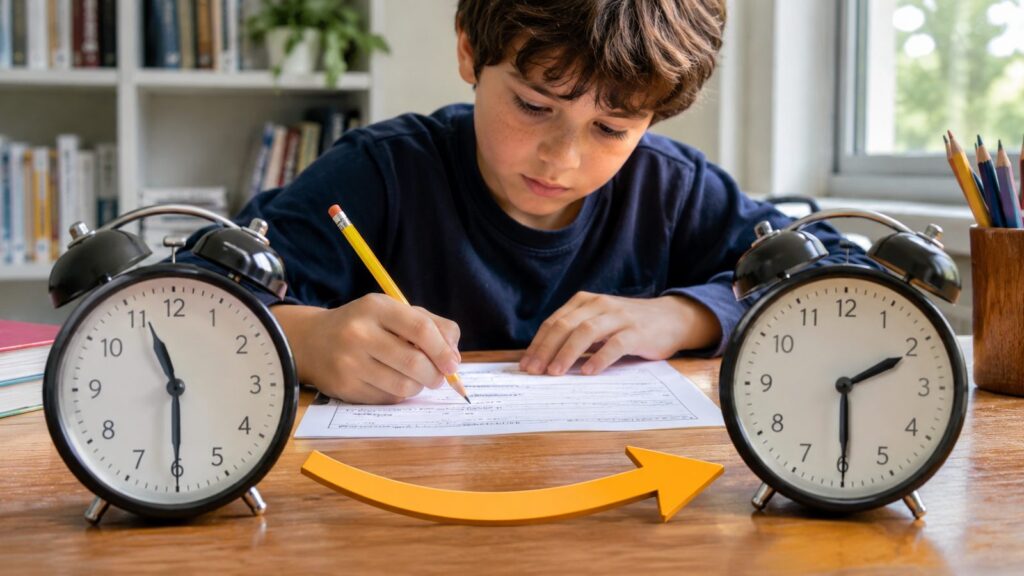
- 10:30 a.m. to 1:00 p.m. = ________
- 11:45 a.m. to 12:25 p.m. = ________
- 9:50 a.m. to 2:10 p.m. = ________
- A trip starts at 11:20 a.m. and lasts 2 hours 15 minutes. Arrival time = ________
Answer Key
- 2 hours 30 minutes. Check: 10:30 to 12:00 = 90 minutes; 12:00 to 1:00 = 60; total = 150 minutes.
- 40 minutes. Check: 11:45 to 12:00 = 15; 12:00 to 12:25 = 25; 15 + 25 = 40.
- 4 hours 20 minutes. Check: 9:50 to 10:00 = 10; 10:00 to 2:00 = 240; +10 = 260 minutes, or 4 hours 20 minutes.
- 1:35 p.m. Check: 11:20 + 40 minutes = 12:00; +1 hour 35 minutes = 1:35; total added = 2 hours 15 minutes.
Practice Set 5: Word Problems
These questions ask students to decide which times matter. Encourage children to underline the starting time, ending time, or duration before calculating.
- Maya starts homework at 4:20 p.m. and finishes at 5:05 p.m. How long does she work? ________
- Soccer practice starts at 3:35 p.m. and lasts 1 hour 20 minutes. What time does it end? ________
- A family leaves at 11:25 a.m. and reaches a park at 1:10 p.m. How long is the trip? ________
- Noah goes to sleep at 11:40 p.m. He wakes at 12:20 a.m. How much time passes? ________
Answer Key
- 45 minutes. Check: 4:20 to 5:00 = 40; 5:00 to 5:05 = 5; total = 45 minutes.
- 4:55 p.m. Check: 3:35 + 1 hour = 4:35; +20 minutes = 4:55.
- 1 hour 45 minutes. Check: 11:25 to 12:00 = 35; 12:00 to 1:00 = 60; 1:00 to 1:10 = 10; total = 105 minutes.
- 40 minutes. Check: 11:40 p.m. to midnight = 20; midnight to 12:20 a.m. = 20; 20 + 20 = 40.
Practice Set 6: Find the Start Time or End Time
Missing-time problems require students to decide which direction to work. Count forward when the end is missing. Count backward when the start is missing.
- Start: 7:45 a.m. Duration: 35 minutes. End: ________
- Start: ________. Duration: 50 minutes. End: 3:10 p.m.
- Start: 10:50 a.m. Duration: 1 hour 35 minutes. End: ________
- Start: ________. Duration: 2 hours 15 minutes. End: 1:30 p.m.
Answer Key
- 8:20 a.m. Check: 7:45 + 15 minutes = 8:00; +20 minutes = 8:20; total = 35 minutes.
- 2:20 p.m. Check: 2:20 + 40 minutes = 3:00; +10 minutes = 3:10; total = 50 minutes.
- 12:25 p.m. Check: 10:50 + 10 minutes = 11:00; +1 hour = noon; +25 minutes = 12:25; total = 95 minutes.
- 11:15 a.m. Check: 11:15 + 45 minutes = noon; +1 hour 30 minutes = 1:30 p.m.; total = 2 hours 15 minutes.
How Parents and Teachers Can Use These Practice Sets
Start with a level that feels manageable instead of beginning with the hardest page. Ask the child to explain each jump aloud before writing the answer. This makes errors easier to find than checking only the final number. Students who need more support can draw a number line or use a teaching clock. Stronger students can solve mentally and then use a second strategy for verification. For broader learning-related reading, Magclone also has an Education section. Avoid turning every exercise into a speed test. Accuracy and clear reasoning matter more while a child is learning the concept. Magclone’s step-by-step writing guide for students also illustrates how breaking a larger task into smaller steps can make work more manageable.
Common Mistakes to Watch For
Students sometimes treat clock notation like ordinary decimal numbers. They may think 2:50 plus 20 minutes equals 2:70. Remind them that 60 minutes creates a new hour. Another common mistake is forgetting the a.m. or p.m. change at noon. Drawing a clear mark at 12:00 helps students see that transition. The same technique works at midnight. Some children also subtract the hour numbers before considering the minutes. Counting forward is often safer at this stage. It shows exactly where each part of the interval comes from.
FAQ About Elapsed Time Worksheets
What grade learns elapsed time?
Students often begin simple time-duration work in the early elementary grades. Grade 3 places stronger emphasis on solving intervals in minutes under Common Core 3.MD.A.1. Grades 4 and 5 can extend the skill through harder schedules and multi-step problems.
What is the easiest way to teach time intervals?
Start with whole hours and use a clock or number line. Move next to half hours, quarter hours, and five-minute increments. Introduce crossing noon and midnight after the child understands ordinary hour changes.
Should students count forward or subtract?
Counting forward is often easier for elementary students because each jump remains visible. Subtraction can work once students understand how 60 minutes form an hour. Teaching both methods gives children a way to check their work.
Can these exercises be printed?
Yes, the practice sets above use simple printable-style text and plain blanks. Parents or teachers can print the webpage or copy selected sections into a classroom document. No separate PDF or downloadable file is required.
Build Confidence One Level at a Time
Time problems become easier when students can see the interval instead of guessing at subtraction. Begin with friendly hour marks, then move toward smaller minute jumps. Keep asking students to explain how they know an answer is correct. Use the six sets as classwork, homework, tutoring practice, or a short review station. Repeat any level where errors appear before moving forward. A number line, T-chart, or clock model can remain available until the child no longer needs it. —