
Last Updated on September 18, 2026 by Nasir Hanif
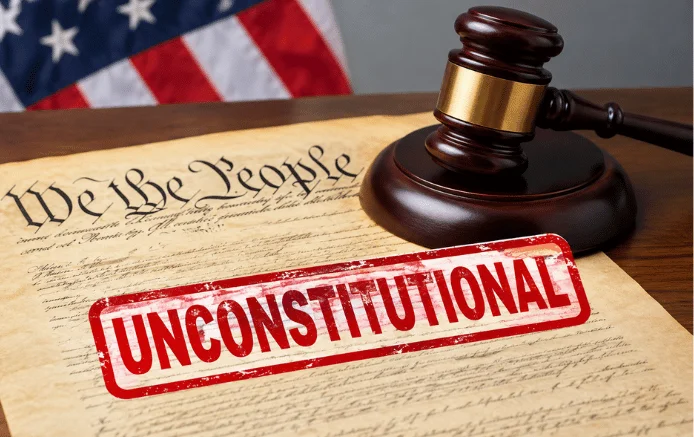
If something is unconstitutional, it conflicts with the U.S. Constitution as interpreted and applied by the courts. The term can describe a statute, executive action, regulation, local rule, or other government conduct. A political disagreement alone does not establish a constitutional violation. A court normally resolves that legal question in a real case.
The Constitution is the nation’s highest legal authority. Article VI identifies it, valid federal laws, and treaties as the “supreme Law of the Land.” Courts use constitutional text, precedent, and the facts of a dispute when deciding whether government action crosses a constitutional limit.
| Key question | Plain-English answer |
|---|---|
| What does the term mean? | A government law or action conflicts with the Constitution. |
| Who decides in a legal dispute? | Federal or state courts with jurisdiction over the case |
| Can Congress violate the Constitution? | Yes. |
| Can presidents or agencies violate it? | Yes, government action can face constitutional review. |
| Can state and local laws violate it? | Yes. |
| Does every illegal act violate the Constitution? | No; ordinary illegality and constitutional invalidity are different questions. |
| What can happen after a ruling? | Enforcement may be blocked, limited, or invalidated depending on the case. |
For more plain-English coverage of legal concepts, readers can also browse Magclone’s Law section.
What Does Unconstitutional Mean in U.S. Law?
The basic idea is simple: government must operate within constitutional boundaries. Those boundaries include limits on government power and protections for individual rights.
The Supreme Court’s authority to review government action developed through judicial review. The Constitution does not expressly state that federal courts may strike down legislation. The Supreme Court established that principle in Marbury v. Madison in 1803.
That case involved a dispute over William Marbury’s judicial commission. The Court concluded that part of the Judiciary Act of 1789 conflicted with Article III. The decision became a foundation of American constitutional review.
Judicial review does not mean judges can reject laws because they dislike the policy. Courts need a legal conflict between government action and a constitutional rule, right, or limitation.
Common Reasons Courts Find Government Action Invalid
Constitutional disputes arise in many areas, but several patterns appear often.
A law infringes a protected right.
The Bill of Rights protects freedoms and interests such as speech, religion, due process, and protection against unreasonable searches.
The Fourth Amendment, for example, governs many government searches and seizures. The exact constitutional standard changes with the setting and facts. Magclone’s guide to strip-search laws and Fourth Amendment rights shows why a legal result can turn on where a search occurred and how officials conducted it.
Government exceeds its assigned power.
The Constitution divides authority among Congress, the president, the federal courts, and the states. A constitutional problem can arise when one branch acts outside its lawful power.
This is why constitutional cases are not limited to individual rights. They can also concern federalism, separation of powers, or the limits placed on a particular branch.
A law violates equal protection.
The Fourteenth Amendment prevents states from denying people equal protection of the laws.
A well-known example is Loving v. Virginia. In 1967, the Supreme Court invalidated Virginia laws that prohibited interracial marriage. The decision rested on the Fourteenth Amendment’s Equal Protection and Due Process Clauses.
A criminal law is too vague.
People need fair notice of conduct that can expose them to punishment.
The Supreme Court has invalidated federal and state criminal statutes for vagueness when they lack enough clarity. An unclear law can also create a risk of arbitrary enforcement.
A rule sweeps too broadly.
First Amendment cases can involve the overbreadth doctrine. A law may cover legitimate government concerns while also restricting a substantial amount of protected expression.
Courts sometimes allow facial challenges in this area because overly broad rules can discourage protected speech before anyone tests the boundary.
How Courts Decide Whether the Constitution Has Been Violated
There is no single test for every constitutional claim. The legal standard depends on the right, classification, government action, and constitutional provision involved.
For some equal-protection disputes, courts use different levels of scrutiny.
Rational basis review is generally the least demanding standard. A law ordinarily needs a rational relationship to a legitimate government interest. Cornell’s Legal Information Institute explanation of rational basis review notes that courts commonly use it when no fundamental right or suspect classification is involved.
Intermediate scrutiny applies in certain categories and requires a stronger government justification.
Strict scrutiny is the most demanding of the three commonly discussed standards. It can apply when government action burdens certain fundamental rights or uses suspect classifications. The government must satisfy a much higher constitutional standard.
This explains why two constitutional cases can produce different results even when both involve government restrictions. The applicable test matters.
Unconstitutional vs. Illegal: They Are Not the Same Question
“Illegal” is a broad term. It generally means conduct conflicts with applicable law.
A constitutional violation is more specific. It concerns conflict with the Constitution itself. Something can violate a statute, regulation, court order, or local rule without presenting a constitutional issue.
The distinction also matters when discussing crimes. A court finding that government conduct violates the Constitution does not automatically mean a public official committed a criminal offense. Criminal liability requires its own legal basis and elements.
Clear legal vocabulary matters in other contexts too. Magclone’s perjury meaning guide explains why a false statement alone does not establish the federal offense. Its exonerated meaning explainer likewise distinguishes exoneration from acquittal, dismissal, and pardon.
Facial Challenges and As-Applied Challenges
A person challenging government action does not always ask a court to eliminate an entire law.
An as-applied challenge argues that a rule violates the Constitution in the particular circumstances before the court. The law may remain valid in other situations.
A facial challenge attacks the law itself across a wider range of applications. The requirements for facial challenges depend on the constitutional doctrine involved. First Amendment overbreadth cases have their own rules.
This distinction helps explain headlines that sound contradictory. One court may block a law in a specific setting without deciding that every possible application fails.
What Happens After a Court Finds a Constitutional Violation?
The result depends on the case, the court, the challenged provision, and the remedy requested.
A court may order any of the following.
- stop enforcement through an injunction;
- invalidate a particular provision;
- prevent the government from applying a rule to certain facts;
- leave other parts of a statute in effect;
- reverse a judgment affected by the constitutional error; or
- send the case back to a lower court for further proceedings.
A Supreme Court ruling can create binding constitutional precedent for lower courts. Lower-court rulings may have a narrower geographic or procedural reach.
The Constitution Annotated table of laws held unconstitutional is a long historical record of federal, state, and local laws that the Supreme Court has held invalid in whole or in part. The examples span subjects ranging from government structure to civil rights and criminal procedure.
A Four-Question Check for Constitutional Claims in the News
Political speakers often use constitutional language before a court has ruled. Readers can assess those claims more carefully by asking four questions.
- What government action is being challenged? Identify the law, order, regulation, search, restriction, or official decision.
- What constitutional provision is involved? Look for the specific amendment, article, clause, or structural principle.
- Has a court ruled on this exact action? A lawsuit, legal argument, or expert prediction is not the same as a final judgment.
- What remedy did the court order? Check whether the decision blocked one application, one section, or the entire measure.
This approach separates a legal ruling from political shorthand. It also gives you a better way to read headlines about executive orders, civil rights, criminal procedure, elections, or government regulation.
Frequently Asked Questions
What makes a law unconstitutional?
A law can fail constitutional review if it violates a protected right, exceeds government power, denies required due process or equal protection, or conflicts with another constitutional limitation. The precise test depends on the claim.
Who can declare a law invalid under the Constitution?
Courts decide constitutional questions when those issues arise in cases within their jurisdiction. Marbury v. Madison established judicial review as a central feature of U.S. constitutional law.
Can an executive order violate the Constitution?
Yes. Presidential and other executive actions remain subject to constitutional limits. Whether a particular order violates those limits depends on its text, legal authority, effects, and the constitutional provision involved.
Is it unconstitutional the same as criminal?
No. Constitutional invalidity and criminal liability are separate legal questions. A government act can violate constitutional rules without automatically establishing that an official committed a crime.
Does a Supreme Court decision erase every part of a challenged law?
Not necessarily. Courts may invalidate one provision, block a specific application, or leave severable portions in force. The opinion and remedy determine the practical effect.
The Key Point
Calling government action constitutionally invalid is a legal claim, not merely a statement that the policy seems unfair or unpopular. The strongest analysis identifies the government action, the relevant constitutional provision, the judicial test, and the court’s remedy. When a real dispute may affect your rights, read the governing decision and applicable state or federal law. For personal legal advice, consult an attorney licensed in the relevant jurisdiction.